


My favourite is the tree outside the cafe that they decorated with big balls. You can see them out the window.
 I read a newspaper article recently about how someone blogged about poor service at a Tesco which resulted in the company actually addressing the problems. So I am going to give it a try. My problem is with Sainsbury's. Several days ago, I received the bottom voucher shown at left. I returned to Sainsbury's a few days later and brought it to the information desk. The staff were very friendly, helpful, understood the problem, and seemed to want to help me. So unlike the blogger that went before me, my problem was not with the local staff. My problem is that Sainsbury's is printing unusable vouchers. You will notice that in another voucher that was left behind by the previous shopper shown in the top half of the image left is for first time on-line use. I am not eligible for that one. But I have included it to demonstrate the presence of the code that the on-line shopper enters to redeem it… and the absence of a code on the coupon that I do qualify for. The numerous staff that helped me all proclaimed the voucher faulty. But there is a problem here. It is not like I just went up to Sainsbury's one day and suggested that they give me £10 if I spend over £50 online. Sainsbury's actually suggested it… and then made it impossible by not including the on-line redeem code. So I am looking for a valid £10 voucher for me and all the other on-line users who spent more that £50 this week because it is the right thing to do.
 The summer days and winter nights in London are longer than in Providence. My six years here is relatively short considering the years I spent in New England, so the length summer days and winter nights are still jarring. For some reason the rapidness of the change in daylight is, for me, most noticeable immediately following the equinoxes. In autumn, my heightened awareness of the quickly advancing wall of darkness is accompanied by the start of the new season of Strictly Come Dancing. I usually do not like these types of shows, but there is something about this one that buoys my spirits. From the incredibly talented orchestra, the wonderfully brilliant delivery of old-fashion wisecracks by presenter Bruce Forsyth, the clarity from judge Craig Revel Horwood on how to get a higher score, the appreciation of dance, the amazing costumes, to the friendly atmosphere amongst of the participants, I love almost everything about it. Maybe it recalls my former self… that part of me that still longs to leap out of my body and meld with a stream of music… and the camaraderie of being surrounded by souls striving for the same transcendence. But maybe my affection is largely due to the timing of the show. As the earth travels through the bleakest part of its orbit relative to the spot I happen to be sitting upon it, I find myself looking forward to the light, jovial nature of the show. Sometimes, when standing on a dark platform waiting a train to or from work, my mind conjures up the energy of the orchestra blasting the theme song with Brucey shuffling his 85-year old feet across the stage as a break from the ominous and increasing darkness, so much darker than the recollections of the winters of my youth.
 I never get sick of looking at buildings and recognisable portions of buildings still in place after thousands of years. So last weekend in Bath was no disappointment. We started with tea in the Grand Pump Room a la Jane Austen who lived in Bath for a while. Someone made a rookie mistake of pouring her tea without straining it, but to save her the embarrassment, I won't name which one of us it was…
 Getting back to the Roman baths, it is fed by a natural hot spring and the Romans built a bath house and temple complex around it. Everything below ground level (which is the tops of those square pillars around the edge of the Great Bath pictured above) is Roman, including the lead-lined baths and the conduits that still today carry the water to and from them. The other malarkey (which I like to call: The Roman Bath Experience) was built by the Victorians. Most museums are very ineffective in their use of audio visual media, but not so here. There is this awesome space that has the exposed foundation and stairs to the bath house to one side, and to the temple on another, and an outdoor altar on another. They put screens at two different spots in that space that start out with you looking at the current view from where your standing and then slowly it layers on more and more of the complex as it looked in Roman times, zooming out and around and then back to where you are standing. It really gives you a sense of the space and changes your whole perspective of the ruins.

 A week or two ago, one of my coworkers brought in a bag of apples that were obviously from an apple tree and not a store. They were delicious. Turns out that there are a couple of apple trees in the hospital grounds that I did not know about. They have been a regular feature of my lunch ever since. I don't even have to carry them in, and they taste great.
 The first of my interesting encounters came when I spotted a locomotive on a side rail. The image left is a model of it. Maybe it is usually there but this is the first time I've seen it. It is a nominated locomotive for hauling the royal train. Until I saw it, I was unaware that there was such a thing.
 My second encounter was with a champagne bar. Self proclaimed as the longest champagne bar in Europe, it opened around the time we moved here and has been haunting me to take my beloved to it as a treat ever since. I finally got around to that this week. The champagne was fantastic. We ordered a little cheese platter to go with it, which came with inedible stone chips in the shape and colour of toasted bread. The bar runs along side the platform where the Eurostar arrives. The Eurostar is a high speed rail service between London and Paris. In my head, this location always had a little bit of a romanticised air. There is a high glass wall that separates the bar from the train. I had always been under the impression that the train traveled under the English channel in a tunnel. But seeing the train roll in, I now wonder if it is simply traveling on the seabed. Wow, was it filthy. Still, I had a lovely time indulging in a little bubbly, and I am glad we finally went.


 Last weekend we visited St Dunstans in the East. It was built in 1100 and repaired and added to until it was destroyed in the Blitz in 1941. The ruin was turned into a public garden in 1971 and is occasionally used for outdoor services. It is even more stunning than the photos suggest. The parish was merged with All Hallows by the Tower, which we also visited. It was also stunning, but in different ways. It has the most amazing roman flooring I have seen so far. It is from a house around 300. I never get tired of seeing bits of really really old buildings. There are some impressive roman artifacts on display in the crypt, and the crypt itself is beautiful. There has been a church here since at least 675. It was also burned in The Blitz but it was restored.
 Photo Credits


 The house is the current residence of the 7th Marquess of Salisbury and contains an almost absurd amount of impressive artifacts and portraits from early modern through contemporary England including the Rainbow and Ermine Portraits of Elizabeth I. The contributions of the Cecil family to the history of England are also too numerous to recount here, but I feel obliged to mention one in particular: Lord Robert Cecil, 3rd Marquess of Salisbury. He served as Prime Minister for 13 years under Victoria and Edward VII. He not only inspired the huge statue at the entrance to the great park on which Hatfield House is situated, but he is thought by some to be the inspiration for the phrase 'Bob's your uncle' from when he appointed his nephew to Chief Secretary for Ireland in 1887.
 Thursday last, we saw Thelma Holt's and the Oxford University Dramatic Society's production of Shakespeare's Comedy of Errors in the Banqueting Hall of the old palace. Our recent viewing of the family photos in the house helped us to recognise that Lord and Lady Salisbury were in attendance. The performance was a clever contemporary interpretation the merged live music, recorded sound and music, meta-reference, immersion, and slow-motion acting elements into it. These elements brought a freshness into the production while still respecting the language and essence of the original. Artemas Froushan and Samuel Plumb as Antipholus and Dromio of Syracuse managed to distinguish themselves despite the magnificently strong ensemble. What a treat!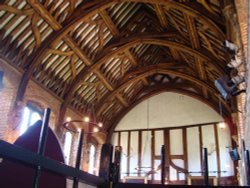
 Moving to a new area means searching for a church with an 8 o'clock service. Luckily, a very conspicuous church at the top of the hill in Old Hatfield obliged. St Etheldreda was a 7th-century Saxon princess who founded an abbey in Ely. The bishops of Ely apparently owned the land when a church was established here in the 13th century, so it seems fitting that the church would share the abbey's patron saint.


